

AI Agents in Quantifier: how autonomous agents deliver compliance faster than traditional tools
Artificial intelligence, in the form of AI Agents, acts as an assistant that accelerates compliance verification. It monitors regulatory changes, assigns tasks to the right people, detects data gaps and generates ready-to-use reports with a full audit trail. As a result, compliance, ESG and cybersecurity teams stop drowning in spreadsheets and start making decisions based on up-to-date information.
The timing matters. Regulatory pressure keeps increasing, and organizations must navigate NIS2, ISO 27001, SOC 2, CSRD, ESRS, whistleblower policies, corporate governance rules and supply-chain requirements. At the same time, the market is debating the maturity of AI solutions, including autonomous agents. What companies need are AI Agents that deliver real, practical value in a regulatory context.
What is an AI Agent in Quantifier?
An AI Agent in Quantifier is an autonomous, intelligent system that supports end-to-end compliance management. It operates as a digital expert running in the background, monitoring regulations, data and processes in real time.
The central compliance agent in the Quantifier platform is Leon, an intelligent, always-available assistant that combines the expertise of a compliance specialist, the precision of an auditor and the efficiency of a project manager.
Leon acts as your digital compliance officer, powered by Quantifier’s AI engine and a knowledge base drawn from hundreds of projects across frameworks such as NIS2, ISO 27001, the AI Act, CSRD, ESG and GDPR.
Leon works like an experienced advisor who:
• translates regulatory requirements into actionable steps
• assigns tasks to the right people
• monitors progress, deadlines and risks
• automatically generates reports aligned with current standards
How it works in practice
Leon operates autonomously within the monitor–analyze–act cycle. The key is the combination of regulatory context understanding, access to operational data and process automation, including task orchestration and audit-ready report generation. This is not a one-off “run the prompt” interaction; it is a continuous compliance engine. The platform, described as an AI-native compliance solution, supports ESG, ISO 27001, SOC 2, NIS and more.
Layers of AI Agent operation
Interaction layer: Leon acts as a conversational guide, answering questions, explaining definitions, helping assign data and tasks, and communicating via the platform interface and email.
Analytical layer: the agents detect data gaps, anomalies, and deviations from standards or internal policies, then recommend corrective actions such as re-verification.
Operational layer: the agent assigns tasks to responsible stakeholders, tracks deadlines, supports four-eye reviews and ensures all evidence is captured.
Reporting layer: it generates compliant reports with a complete audit trail: every figure, document and change is linked to a person and timestamp.
Why call it an agent rather than a chatbot? Because it goes far beyond conversation. An AI Agent guides users through the process, runs document-processing tools, interprets compliance frameworks and performs actions within the system.
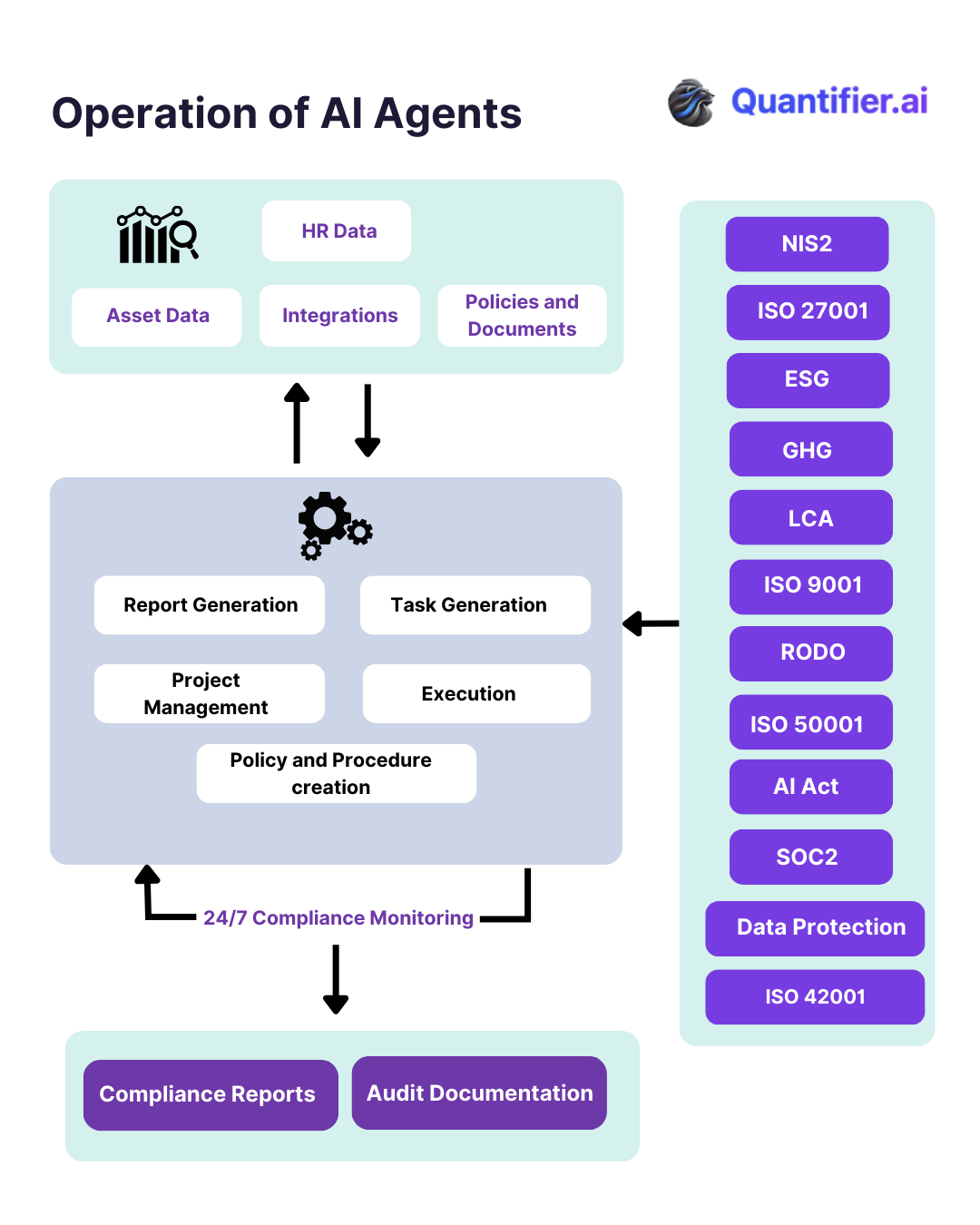
Architecture: from data to decisions with an AI Agent
Data inputs. The AI Agent ingests source documents, transactional and reference data, organizational structure, and role-responsibility mappings. Alongside system integrations, a document-extraction layer converts materials into the structure required by the data repository and reporting modules.
Rule and standard modeling. Standards are anchored in external frameworks: ESRS defines disclosure requirements and materiality, the GHG Protocol sets emission-calculation methodologies, and NIS2 clarifies risk controls and incident reporting. The AI Agent does not “invent” criteria; it aligns data with existing frameworks, consistent with best practices recommended by implementation and advisory bodies.
Task orchestration. When the agent identifies a missing or inconsistent data point, it assigns a task to the responsible person, adds instructions and deadlines, manages approvals and logs all actions. The entire process remains transparent to auditors through the audit trail.
What Leon does in practice
• Guides users through compliance workflows step by step, explaining what needs to be done, why and in what order.
• Analyzes data and identifies gaps such as missing information, documents or risk areas.
• Automatically assigns tasks based on organizational roles, sending targeted requests and reminders.
• Communicates naturally via chat, email or Slack, answering questions and clarifying regulatory context.
• Produces ready-to-use reports and audit trails in PDF, Excel or XBRL formats, always with full change history.
• Learns from each project, gaining deeper understanding of the organization’s structure, processes and risks.
Case studies show that in retail and manufacturing, adopting AI-native compliance accelerates team alignment and reduces the number of reporting iterations. Quantifier focuses on agents anchored in strict regulatory frameworks and measurable workflows.
Summary and future outlook
AI Agents will become increasingly embedded in business applications. Forecasts indicate that within a few years, a significant share of enterprise software will include agent-based components, and many operational decisions will be initiated automatically. Whether a framework contains 24 or 18 requirements does not matter to an AI Agent; if rules are versioned, updating them is just synchronization. Organizations with structured data and processes adapt to regulatory changes far more efficiently.
AI Agents in Quantifier are not gadgets. They are the core of compliance management, combining human interaction with automated data-quality checks, task assignment and audit-ready reporting. In practice, they shift teams from chaotic data collection to a structured, ESRS-, GHG- and NIS2-aligned process ready for audit.
Reports show both rapid AI adoption and a high failure rate among agent initiatives caused by operational immaturity. The strength of an AI-native platform is that the agent operates within clearly defined standards and measurable workflows.
An AI Agent in Quantifier shortens the time to achieve compliance, stabilizes reporting quality and reduces audit-iteration cycles. Organizations that implement it with strong data discipline and four-eye controls gain resilience to regulatory changes and lower long-term compliance costs.