Envirly by Quantifier x Tatuum: together for more sustainable fashion

Envirly by Quantifier collaborates with Tatuum: working together for more responsible and sustainable fashion. ESG in the fashion industry.
Tatuum is a Polish clothing brand founded in 1997. Its first store opened in 1999 on Piotrkowska Street in Łódź. Today, the company manages a network of 125 stores: 102 in Poland and 23 abroad, across the Czech Republic, Hungary, and Slovakia.
- Number of employees: 700
- Reporting year: 2025
- Year founded: 1997
Reporting scopes
- Scope 1 – Direct emissions
- Scope 2 – Electricity
- Scope 3 – Employee commuting and business travel
- Scope 3 – Waste
- Scope 3 – Leased assets
- Scope 3 – Purchased goods and services
Results analysis
Introduction
For more than 25 years, Tatuum’s designers, creating capsule wardrobes for women, have put timelessness, high-quality materials, and refined cuts first. This means Tatuum garments can last for many seasons, helping to combat fast fashion, inefficient resource management, and waste, while aligning perfectly with the goals and principles of sustainable development. It is also worth noting that the company has been steadily increasing the share of collections made from natural and recycled fibres across its overall product offering.
What motivated Tatuum to begin ESG activities
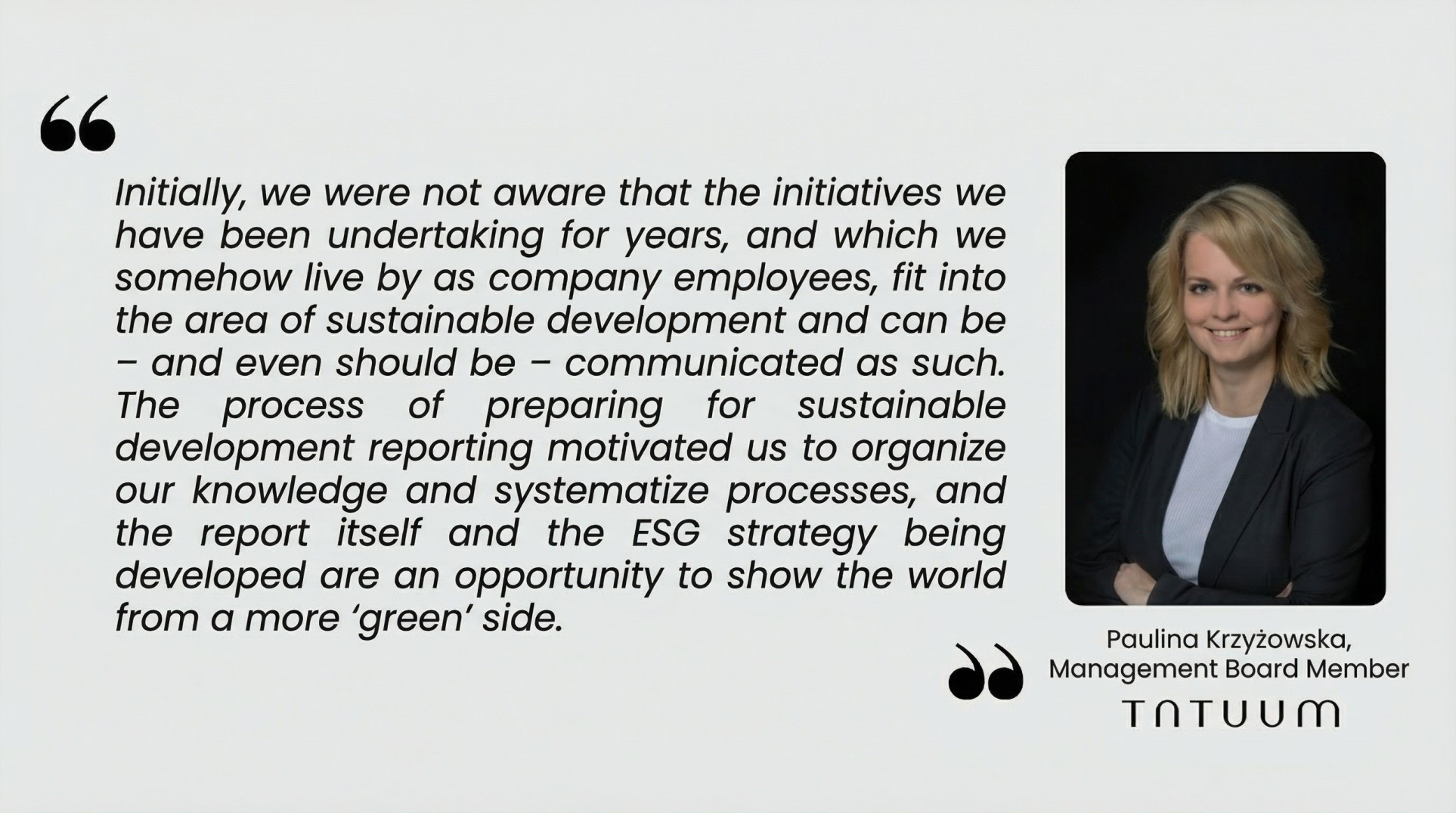
Although sustainability initiatives have long been part of the company’s DNA, the main impulse to consolidate Tatuum’s sustainability efforts came from regulatory requirements connected to the CSRD directive coming into force.
Tatuum views ESG reporting not only as an obligation, but also as an opportunity to educate customers about the importance of everyday choices in building a more sustainable future, as well as a source of tangible financial benefits.
Recent market research confirms that consumers are willing to pay more for sustainable products. The figures vary by study, reaching, for example, 60% (EY Future Consumer Index) and even up to 80% (global studies aggregated by Kearney). In addition, a report published by Flexcon Global shows that 70% of consumers already choose products based on the sustainability of their packaging. Therefore, beyond meeting regulatory requirements, ESG can also be an opportunity to strengthen a company’s competitiveness and image.
What the collaboration between Tatuum and Envirly looks like
Tatuum was looking for a partner who could guide the company through its transformation and introduce it to ESG topics.
Several factors led to the choice of Envirly:
- specialist expertise in ESG,
- a comprehensive offering combining a technology tool with expert advisory support,
- the best value for money,
- access to the Envirly Platform, praised for its intuitive, clear interface and ease of use.
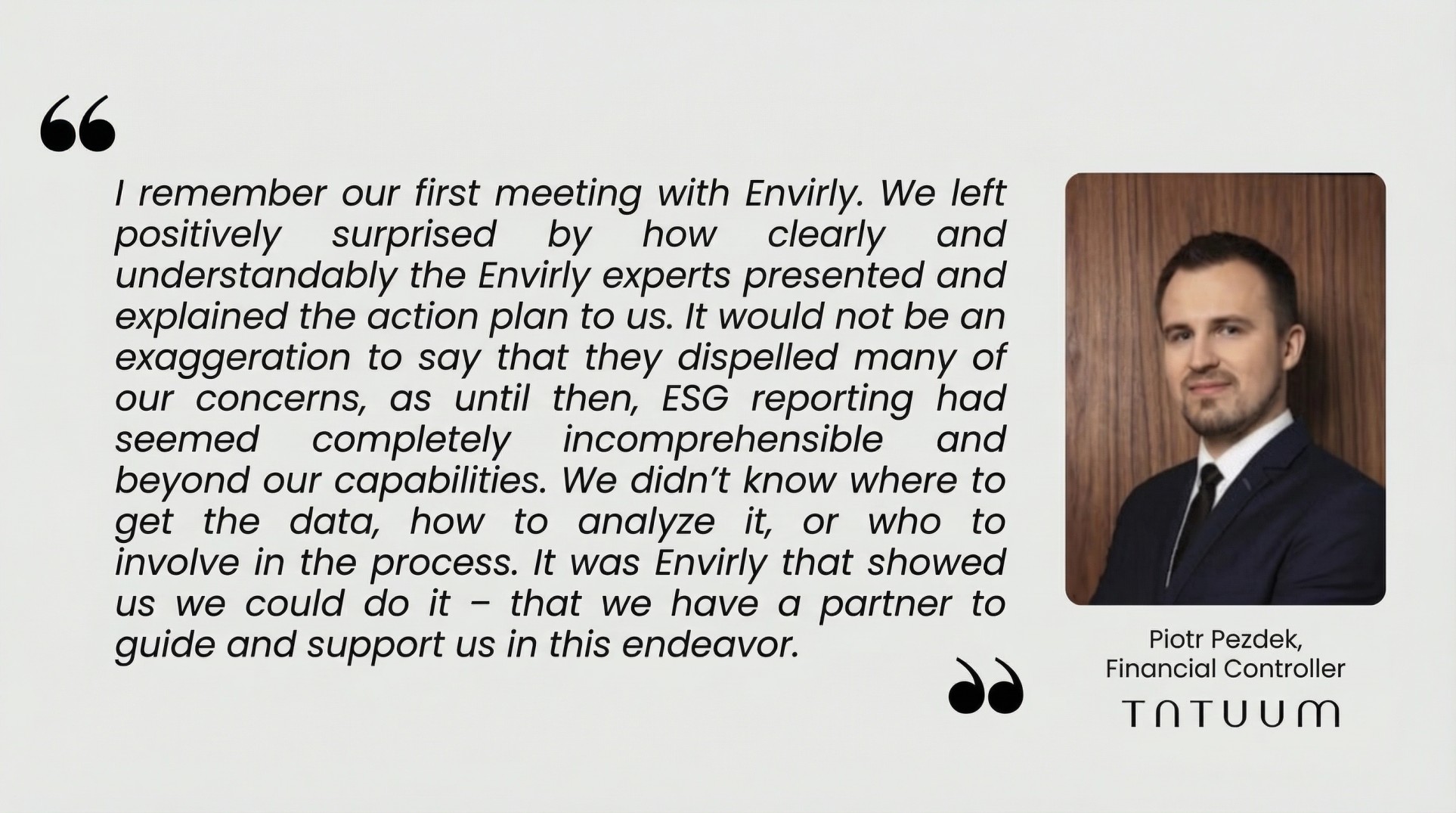
“Envirly’s experts assured us they would guide us by the hand, step by step, showing us how to navigate the maze of ESG regulations. And that’s exactly how it is. I truly feel we’re doing this together, we’re not left on our own, and we can count on support at every stage of the cooperation.”— adds Paulina Krzyżowska, Management Board Member at Tatuum.How the work is organised
When preparations for the sustainability reporting process began, Tatuum decided to establish a “steering committee.” It consists of three people: a Management Board member, a financial controller, and a specialist from the finance and administration department. They are supported by 1–2 representatives from various teams involved in ESG-relevant topics: product, HR, controlling, IT, and logistics. The company also plans to hire additional staff dedicated specifically to ESG matters.
Benefits of sustainability reporting
Greater clarity, transparency, and a deeper understanding of the company’s internal processes and how they can be optimised are just some of the benefits highlighted by Tatuum.
Recommendations for companies starting their reporting journey
“Our advice is to start as soon as possible, because in reality we’re already past the last call, and the organisation still needs time to get used to the ESG reporting process. One person won’t do it, it requires awareness across the whole organisation, which means involvement from all departments. In Poland, with the fast pace and heavy workload, an ESG project without the ‘URGENT’ label can get pushed aside and buried under more pressing matters. I’m glad we didn’t wait at Tatuum. It helped us avoid a lot of stress. Looking back, I can’t imagine starting later. But if we could change one thing, it would be appointing or hiring a person responsible for coordinating ESG activities. It would help avoid a situation where ESG gets deprioritised, because everyone involved in the process also has other, more urgent responsibilities.”— concludes Paulina Krzyżowska, Management Board Member at Tatuum.